Showing posts with label Poetry NZ. Show all posts

Saturday, 16 March 2019

Upcoming events: Massey University World Poetry Day Reading [21/3/19]


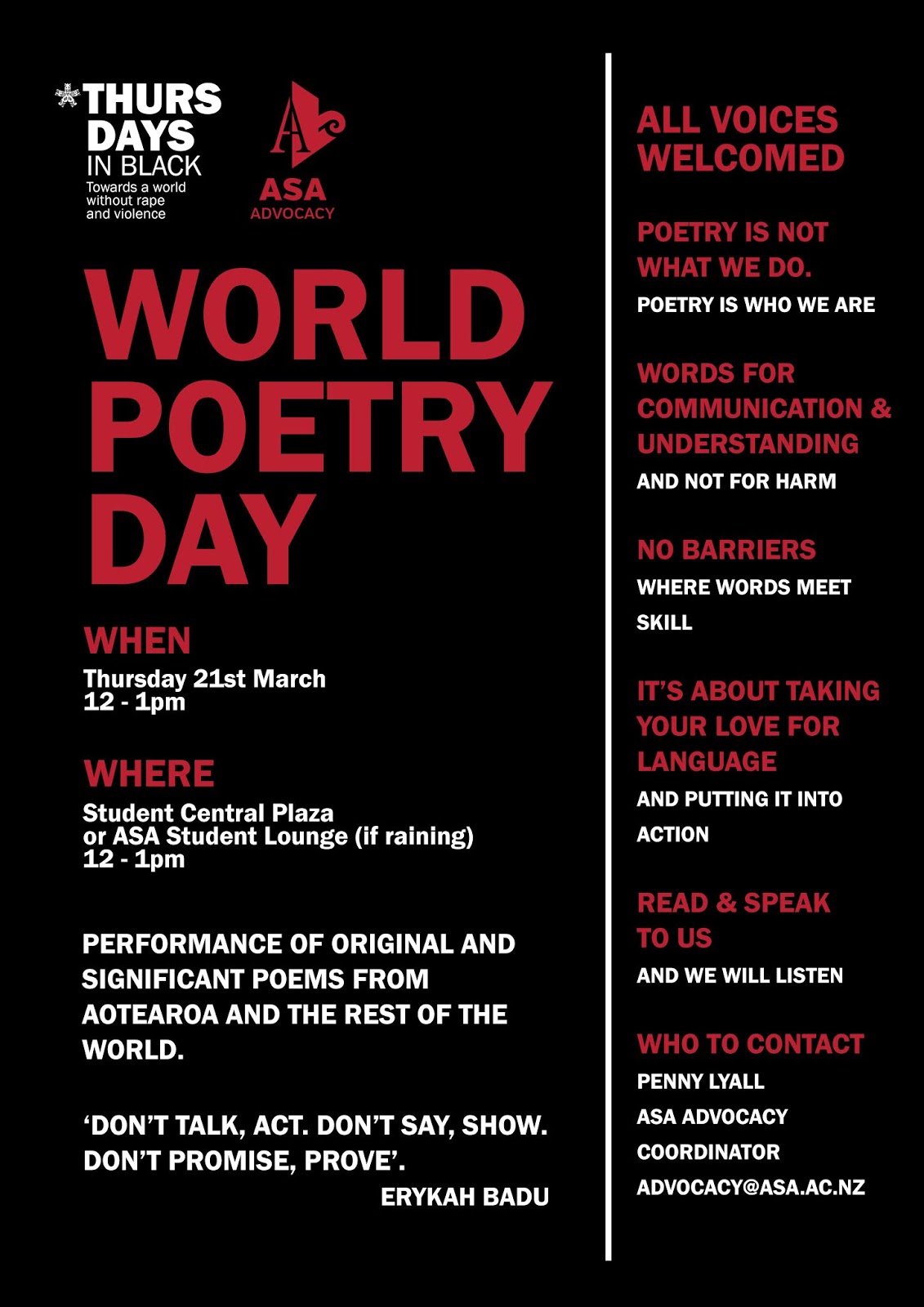
Massey Albany World Poetry Day Reading


Since the brutal terrorist attack on the people gathered for Friday Prayers in two mosques in Christchurch on Friday afternoon, 15th March, I feel that it's more important than ever that we gather together to express our complete rejection of such insane and pointless acts of violence. We thought such things could never happen in New Zealand. We were wrong.


I for one will be wearing black on Thursday, and will go to Student Central in Massey's Albany campus prepared to read and listen to poems dedicated to peace, justice and human understanding. I hope those of you who are in the area can join us. You will be very welcome.


Here is a link to a map of the area. The reading will take place in the East Precinct at midday, outside the building marked '4' on the map above (or inside if it's raining).

Albany Students Association Advocacy Coordinator Penny Lyall stressed, in her original invitation to this event, acts of sexual assault and violence. We continue to utterly repudiate those, but history has now opened up the conversation to force us to include terrorism in the list of things we are fighting against:

Message from Penny Lyall – ASA Advocacy
_________________________________________________

I have just started a new initiative on the Albany Campus called Thursdays in Black. This is to promote that in no way is sexual assault and violence ever acceptable.  Thus to encourage students and staff to actively acknowledge and create a safe culture on campus.

I am attaching the schedule of events that will be held each week for your interest and should you want to promote and display them somewhere.

What is of particular interest is that we will be recognising and celebrating World Poetry Day on the Thursday 21st March (Student Central Concourse or ASA Student Lounge if raining) ..

We are hoping that students and staff (both academic and general staff) will come along and perform original poems or just read poems aloud that touch them.

Jack Ross and Bryan Walpert and are both hoping to come along for a while and may perform.  

I would love a good selection of students and staff present performing or just listening.

Kind regards
Penny


Penny Lyall
Advocacy Coordinator
Albany Students' Association Inc
Level 2, Student Central, Massey University Albany Campus
Private Bag 102904, NSMC, Auckland, 0745

ddi: 09 213 6074 |  int: 43074 | mob: 027 426 7861
[www.facebook.com/albanystudents]www.facebook.com/albanystudents


Massey Albany Thursdays-in-Black Schedule


Tuesday, 12 March 2019

Radio NZ: Jesse Mulligan 1-4 [11/3/18]

Celebrating New Zealand poetry

From Jesse Mulligan, 1–4pm, 1:28 pm on 11 March 2019
No caption
Photo: Supplied

Poetry New Zealand Yearbook's 2019 edition is out now, focusing on Hamilton poet Stephanie Christie, and containing more than 120 poems.

The country's longest-running poetry journal also features the work of young kiwi poets, winners of the inaugural competition for high school students.

Dr Jack Ross, senior lecturer at Massey University and managing editor of Poetry New Zealand, joins us now to give us a taste of what's in the yearbook.


Jack Ross


Sunday, 5 August 2018

Upcoming events: Massey University Poetry Day Reading [24/8/18]


Title: Massey University Reading for National Poetry Day!
Description: Come hear an hour of poetry from emerging, up and coming local poets.
Entry details: Free and open to the public
Time/Date: 12-1.30 p.m, Friday 24 August 2018
Location: AT2, Atrium Building, Massey University Albany Campus
Contact: Bryan Walpert (b.walpert@massey.ac.nz) or Jack Ross (j.r.ross@massey.ac.nz)
Further info: For further information, please contact Bryan or Jack.


Wednesday, 1 August 2018

Submissions closed for Poetry New Zealand 53


Poetry New Zealand on Fouras beach, côte Atlantique
[photographs: Michael Dean]


Yes, I'm afraid that time has come again: time to fold up your towels and come in out of the sun - submissions for Poetry New Zealand Yearbook 2018, issue no. 53, due out in early 2019, are now officially closed.


Fold up that towel!


I'll continue to add various commissioned reviews and other bits and pieces to the text, but any unsolicited work that's sent to me from now on will have to be sent back. You're welcome to start preparing your material for Yearbook 2020 [Issue 54], but it might be better to hold off on that until mid-2019. Once again, we'll be following the convention of accepting entries from Mayday until the end of July.

Some of you may have been feeling a bit uneasy about the lack of a reply to the work you've sent. It's not really practical to acknowledge each submission as it arrives. I do hope that only a very few of you will be kept waiting more than three months from the date of receipt, however.

So please do rest assured that we're working through them all, and that each of you will receive a reply in the very near future.


Wednesday, 14 March 2018

Radio NZ: Jesse Mulligan 1-4 [14/3/18]

2018 New Zealand Poetry Yearbook


From Jesse Mulligan, 1–4pm, 1:31 pm today

The upcoming 2018 Poetry Yearbook includes 130 new poems from 87 poets. It has a skew for 2018 towards younger writers including those who are still in their teens. It also features the 2018 Poetry Prize Winner's work. That was won by an Otago University Medical student, Fardowsa Mohamed. The Yearbook's editor Jack Ross talks to Jesse about the quality of this year's book and the talent of the country's younger poets.

Jack Ross


Short Story Club


Every Thursday after 3pm Jesse and a guest discuss a New Zealand short story, and read feedback from listeners.

On Thursday 15th March we will discuss the poem Us, by Fardowsa Mohamed.

We brought in an overseas expert to discuss her poem. Poet, editor and fan of New Zealand, Matthew Zapruder.

He has an excellent book called Why Poetry, which is a great place to start for somebody wanting to enjoy poetry more.

Fardowsa Mohamed

Us
for my sisters

i.

Mother, you did not expect to find yourself
in this forest of strange trees.
This ground does not taste
of the iron your tongue knew.
in the velvet of the night we heard you sob
in the room next door, our ears pressed to the peeling paper.
we locked fingers and prayed. someone next door
saw braided-head girls in a circle
praying to a peculiar god
and snapped their curtains shut.

ii.

Everyone congratulates me
on the scholarship. Your parents
who have suffered can finally exhale

said the white man at the ceremony.
But I think I hate this degree.
I want to do good and make a difference
but I have no idea
how to be in this foreign land.

iii.

the world broke & crumbled today
— there you go — trying to tape her back
into a perfect sphere,
trying to spit water
on the raging fire.

iv.

know that this earth is your body. your words are
the Pacific Ocean tides that wash & purify
your legs are the Mountains that anchor, your heart —
the Land that gives. every where you stand is your home.
Earth is the African Woman
who gave birth to the first Man.

v.

We were watching late night Al Jazeera, shaking our heads,
when uncle called. A pregnant cousin we have never met has died.
The TV breaks to a Red Cross appeal.
You hold me on the sinking couch
as we mourn those whom we never knew.


Tuesday, 1 August 2017

Submissions closed for Poetry New Zealand 52


Yes, I'm afraid it's official: submissions for Poetry New Zealand Yearbook 2018, issue no. 52, due out - I hope - in March next year, are now closed. I'll continue to add various commissioned reviews and other bits and pieces to the text, but any unsolicited work that's sent to me from now on will have to be sent back. You're welcome to start preparing your material for Yearbook 2019 [Issue 53], but it might be better to hold off on that until mid-2018 (we'll be following the usual convention of accepting entries from Mayday until the end of July).

Some of you may have been feeling a bit uneasy about the lack of a reply to the poems you've sent. It's not really practical to acknowledge each submission as it arrives (there've been over 300 for this issue: a new record). I hope that very few of you will be kept waiting any longer than three months from the date of receipt.

So please do rest assured that we're working through them all, and that all of you will receive a reply in the very near future.

So much has been sent, however, that there will inevitably have to be a lot of rejection letters. We all hate writing them, but it must be done. I can already see that there's some fantastic material in my inbox, but there are logistic limits on what even a publisher as supportive as Massey University Press will allow me to include between one set of covers.


Monday, 27 March 2017

Radio NZ: Standing Room Only [26/3/17]


Standing Room Only

Originally aired on Standing Room Only, Sunday 26 November 2017:


The Poetic Landscape of Aotearoa 2017

The country's longest running poetry magazine has just put out issue 51, an impressive tally in anyone's book. Lynn Freeman spoke to Jack Ross who has edited Poetry New Zealand: Yearbook 2017, featuring new and well established writers. Jack has selected 125 new poems from hundreds submitted internationally, and supplemented them with essays and reviews by other writers keen to get people talking more about poetry.

Duration:  11′ 20″ 


Friday, 16 December 2016

More free PNZ downloads for Christmas


Nicholas Reid, ed: Poetry NZ 46 (2013)


Alistair Paterson, ed: Poetry NZ 47 (2013)


Nicholas Reid, ed: Poetry NZ 48 (2014)


Jack Ross, ed: Poetry NZ Yearbook 1 (2014)


As a special Christmas treat, and also by way of an apology for letting a whole year go by without an issue of Poetry New Zealand, we've decided to make the complete pdf files of issues 46, 47, 48, and 49 available as free downloads from the Poetry NZ website.

We'd been selling them previously for $NZ 10 each, but from now on all four of them (as well as issue 50) will be free to a good home. Look near the top of the left margin of the each issue's webpage. You'll see, in little red letters: "Free PDF download." Click there.

As part of the changes necessitated by the shift to our new publisher, Massey University Press, we will be selling each annual issue separately in future, and no longer as part of a one or two-year subscription. Our existing obligations under the old subscriptions policy will, of course, be fulfilled, but Poetry New Zealand Yearbook will henceforth be sold through the MUP website, as well (of course) as in good bookshops everywhere. You can still buy copies of the current issue through the Poetry NZ website, but from now on the payments will go through MUP.

This offer of the free downloads is also meant as a thank you to all those valiant subscribers who’ve kept the magazine afloat for so many years. It goes without saying that we’re still going to need your support to continue, but it now seems more practical to market each issue as a discrete item, rather than as part of a package.


Jack Ross, ed: Poetry NZ Yearbook 1 (2014)


Tuesday, 13 December 2016

Interview on The Review Review [13/12/16]


"I Take Poetry Pretty Seriously."
A Chat With Jack Ross, Editor of Poetry New Zealand


This interview, by contributing editor Sanjeev Sethi, appeared in the The Review Review on 13th December 2016:

From the bowels of New Zealand breezes in Poetry New Zealand, each issue fragrant with literary flowers in the shape of poems, stories, reviews encapsulating rich and rewarding fare. Curating this creative smorgasbord is Dr. Jack Ross, the accomplished and erudite poet-writer-academician. A PhD in English from Edinburgh University, Ross is a Senior Lecturer in Creative Writing at Massey University's Albany campus.

Briefly tell our readers about yourself?

I work at Massey University, where I’ve been teaching various types of writing for the past twenty years. The principal focus of my own writing has, however, always been poetry, even though I’ve also published a number of novels, essays and other works of fiction and criticism.

As well as that, I run a blog, The Imaginary Museum [http://mairangibay.blogspot.co.nz], devoted to bookish matters generally.


Poetry New Zealand, “devoted exclusively to poetry and poetics,” started in 1951. Over the years, how do you see its evolution?

Poetry NZ began as an alternative to the centralising trends in New Zealand writing at that time, after the war, when New Zealand had just completed its first century of colonial occupation. The democratic and open-minded approach of its first editor, Louis Johnson, has (I hope) continued to inspire it in each of its various incarnations.

The longest-serving editor has been Alistair Paterson, who presided over the magazine for twenty years–from 1993 until I took over in 2014. He introduced a strong focus on poetics and experimental writing, as well as trying to forge stronger links internationally: with the UK, the USA, and also non-English-speaking writers, such as the French poets of New Caledonia.


A basic question: what is a good poem? Do you think this definition is culture-specific?

For me, a good poem is a piece of writing which is lively and provocative enough to force me ask myself if it really is a poem. In that sense, yes, it’s a personal as well as a culture-specific definition, since my own boredom with what I see as tired and conventional solutions to the problem of (as Kafka put it) “breaking the frozen sea within you” may not apply directly to other readers. They might see a book of neo-Shakespearean sonnets as enchanting, while I might see them as pointless and hackneyed. That’s not to say that I think it impossible to write a good poem in conventional metrical forms nowadays: just that I feel some significant re-imagining has to have taken place to make it really qualify as what I would call a poem.


While reading a submission can you gauge which part of the world the contribution is from?

Sometimes. Not always. One advantage of electronic submission methods is that I often have no idea where an author is from. It is, in any case, very secondary to me in comparison to the question of whether or not I like their work.


According to you, which part of globe is creating the best contemporary poetry?

New Zealand. No, seriously, I think in an age of mass communications it’s impossible to see any regions as particularly privileged creatively. I do think our poets write as well as anyone, though. There’s always been a do-it-yourself, anything-goes mentality here that encourages our writers to try crazy and offbeat things. I like that a lot. We haven’t been trained to avoid the usual mistakes, and the results can often be quite spectacular.


What must a submission have not to get a No from you?

Statistically, a massive number of submissions to the magazine will receive a “No:” at least two thirds of the work that’s been sent in, in fact. I regret that, but it does mean that I can let through only the pieces I’m really certain of.

Sending just one poem rather than our recommended selection of five is a good way to get rejected. Often it’s the last poem, the afterthought, in a group of submissions that really grabs me.

Another way to get rejected is to write so carelessly, with so many typos and grammatical errors, that it’s clear that your work has scarcely been edited. At times one wonders if it’s even been reread by its author! If you take no pride in the exactness and precision of your words, you can hardly expect me to supply that for you.

A naïve, direct poem by a first time author can often be very good. I’m sure I include some such poems in every issue. In general, though, just as with any other art, if you don’t know anything about poetry: hardly read it, are ignorant of technique, have never studied its history, that’s not really a great start.

I take poetry pretty seriously: it fascinates me, in fact. But it’s just like learning a foreign language: you can pick up a few phrases on the street, and eventually learn to get by in conversation, but you’ll never be really fluent unless you devote time and energy to it.


Any favourite themes?

I do try to be pretty eclectic in my tastes. I must confess to a bit of prejudice in favour of poems with a narrative dimension, though. If your poem tells a story, it’ll probably get my attention more quickly than if it indulges in complicated wordplay or lengthy landscape evocation.


Do you think a vibrant critical climate helps in nurturing poetry?

Absolutely. Very much so. At present Poetry NZ maintains a ratio of roughly one third critical writing (essays, interviews and reviews) to two thirds poetry. I’d like–if possible–to increase that over time. I’d be quite happy to see the ratio running half and half.

There really is no point in a cacophony of voices all shouting as loud as they can–many of them, alas, more interested in promoting their own careers than improving the quality and appeal of their work–if there’s no strong structure of critical writing and thought behind it.

I try to commission reviews of as many as possible of the poetry books that appear in New Zealand, as well as a number of international ones. As I’m sure you know yourself, though, reviewing is a difficult and thankless task, and it does require a certain subordination of the ego which not everyone is willing to make.


Any last words?

Yes, I’d like to conclude by saying that while the main focus of Poetry NZ must remain an anatomy of the nature of the poetry produced in this country – in itself a massive task – the last thing I think we should be doing is cutting ourselves off from international trends in poetry. Poets from elsewhere will always be welcome to submit to us, and there’s absolutely no requirement for them to address – or even think about – specifically “New Zealand” issues when they do so.

If you send us your best work, we’ll be happy to include it. And that goes for work in translation and dual-text, too. New Zealand is both a multicultural and a multi-lingual society now, and a true reflection of its poetic identity involves vital questions of language as well as culture.

As a postcolonial state, New Zealand (like many other countries) is only now beginning to come to terms with the theft of land and sovereignty from its indigenous inhabitants, the Maori. That’s as much of a poetic as a political issue for us. We have to try to imagine our way out of these blank walls of hatred and suspicion, try to create a harmony based on mutual respect and justice.


Sanjeev Sethi has published three books of poetry. This Summer and That Summer (Bloomsbury, 2015) is his latest. His poems have found a home in Solstice Literary Magazine, Off the Coast Literary Journal, Hamilton Stone Review, Literary Orphans, The Bitchin’ Kitsch, Pyrokinection, Café Dissensus Everyday, Section 8 Magazine, The Jawline Review, The Helios Mss, Right Hand Pointing, Revolution John, Futures Trading, The Aerogram, The Mind[less] Muse, Creative Talents Unleashed, Chronogram, Duane’s Poe Tree, The London Magazine, The Fortnightly Review, Ink Sweat and Tears, Sentinel Literary Quarterly, Allegro Poetry Magazine, Amaryllis Poetry, New English Review, The Galway Review, A New Ulster, In Between Hangovers,  The Open Mouse, Otoliths, and elsewhere. He lives in Mumbai, India


Monday, 15 February 2016

Indexing Poetry NZ


Joseph Severn: Shelley at the Baths of Caracalla (1845)


Her's the text of my latest post on The Imaginary Museum [14/2/16]:
“Now my summer task is ended,” wrote Shelley, as he reclined in a rowboat, having just completed his massive 12-canto epic Laon and Cyntha (1817).

My summer’s task has been somewhat less creative - though I have to confess that at times it seemed every bit as arduous - compiling a comprehensive online index for the journal variously known as New Zealand Poetry Yearbook (1951-1964), Poetry New Zealand (1971-84), Poetry NZ (1990-2014), and – now – Poetry New Zealand Yearbook (2014-?).

Over the past 65 years, 67 issues of this magazine have been issued by publishers including A. H. & A. W. Reed, Pegasus Press, John McIndoe, Nagare Press, Brick Row Publishing, Puriri Press, Massey’s School of English and Cultural Studies, and – now – Massey University Press.

These 67 issues, edited by 16 editors, contain 6784 pages of material: editorials, essays, reviews, and – of course – many, many poems, reviews and essays by 947 authors (but who's counting?).

And what have I learned from this extremely laborious exercise? Well, I suppose it’s given me a renewed appreciation for the sheer coverage achieved by this journal in its two-thirds of a century of existence. Who, among New Zealand’s canonical poets and writers, isn’t there? Adcock, Baxter, Curnow, Doyle, Glover, Hyde, Manhire - you name them, chances are they're there (as you can readily verify by visiting the Author index page).

And then there are the overseas contributors: Charles Bernstein, Charles Bukowsky, Robert Creeley, August Kleinzahler, Les Murray - again, the list goes on.

How should you use the index? Well, the quick answer is to go here, where I've given some brief instructions on the subject.

If you're curious, though, I'll just remarks that it is – in conception, at least – as simple as I can make it. There’s a separate page for each issue, with images of the Front and Back Covers, Title-page and Copyright details, and the Table of Contents: together with any details I can find about such matters as the Contributors and the Subscription Details - on average, ten separate images per issue.

If you want to know about a particular issue, you can either link to it from the right sidebar of the site, or – alternatively – from the Contents or Site-Map pages.

If, however, you want to know what a particular author has published in Poetry New Zealand over the years, you can go to the Author Index page, which provides a numbered list, alphabeticised by surname, together with chronological details of each writer's contributions. You can imagine how much fun it was putting that together!

No doubt there are still many typos and other errors left, though I've tried to proof-read it as carefully as I went along. 1,000-odd A4 pages of material provides scope for a good many mistakes, however. I’d appreciate it very much if you would alert me to any lacunae you detect, and promise to correct them as soon as I can. You could start by checking the details of your own contributions to the magazine over the years, perhaps.

For the rest, I’m not really proposing that anyone should try to read this monstrous compilation for pleasure, but hopefully future researchers into modern New Zealand poetry may find it of some use. It’ll certainly be a great help to me as the present editor of the magazine.

Enjoy!

Tuesday, 17 November 2015

The Choice of a Cover Image for Yearbook 2


Cover image: Karl Chitham / Cover design: Anna Brown


The cover image for Poetry NZ Yearbook 2 comes from a series of maquettes by artist Karl Chitham (Ngāpuhi). At the time he made the models in question he was working as a curator at the Rotorua Museum, which may explain why this one appears to recall the famous pink and white terraces. Karl, however, has transformed them into congealed pools of white and sulphur-coloured paint, with a wharenui standing proudly on top.


Image: Karl Chitham


If you want to know more about Karl, currently employed as the new director of the Tauranga Art Gallery, do read the article here:


Given our choice of Robert Sullivan as our feature poet for this issue, Karl seemed the ideal choice for a cover artist. Especially as the two of us collaborated on the exhibition Fallen Empire (Dunedin: Blue Oyster Gallery) in 2012 (for which see more info here).


Robert Sullivan (2015)


There are many other people I would like to celebrate for their work on this issue: our administrator, Bronwyn Lloyd; our new social media guru, fiction and screen writer Matthew Harris; but our cover designer Anna Brown, of the Design Studio at Massey, deserves extra high praise for working to the narrowest of deadlines to come up with this wonderful cover for us:


Thanks, then, to one and all! The issue is now with the printers, and should be winging your way by the end of the month.


Tuesday, 13 October 2015

LOUNGE #47 Reading (21/10/15)


The completion of the latest issue (Yearbook 2 / Issue #50) of Poetry NZ will be celebrated next week at one of the nzepc's celebrated LOUNGE readings in Old Government House, Auckland.

Here are the details of the event:


LOUNGE #47


with readers:

Stu Bagby
Peter Bland
Roger Horrocks
Sophia Johnson
Michele Leggott
Bronwyn Lloyd
Vana Manasiadis
Elizabeth Morton
Lisa Samuels
Robert Sullivan

MC: Jack Ross

Wednesday 21st October, 5.30-7.00 pm

At Old Government House
Auckland University City Campus
corner of Princes St and Waterloo Quadrant


Free entry. Food and drinks for sale in the Buttery.
Information Michele Leggott, or 09 373 7599 ext. 87342


The LOUNGE readings are a continuing project of the New Zealand Electronic Poetry Centre (nzepc), Auckland University Press and Auckland University English, Drama and Writing Studies, in association with the Staff Common Room Club at Old Government House, and — in this case — Poetry NZ.

See you there!

There will be a number of giveaways during the evening: free copies of Tender Girl, by Lisa Samuels; A Clearer View of the Hinterland, by Jack Ross; and a voucher for a free copy of the unfortunately-not-yet-back-from-the-printer Poetry NZ Yearbook 2.


Photos by Tim Page:


Lounge 47


Stu Bagby


Peter Bland


Roger Horrocks


Sophia Johnson


Michele Leggott


Bronwyn Lloyd


Vana Manasiadis


Liz Morton


Lisa Samuels


Robert Sullivan


MC: Jack Ross


Monday, 8 December 2014

Poetry NZ Wellington Launch [1/12/14]


Cover image: Renee Bevan / Cover photograph: Caryline Boreham
/ cover design: Ellen Portch & Brett Cross


POETRY NZ LAUNCH

As part of Massey University’s sponsorship of the Australian Associated Writing Programmes Conference, we are proud to launch the Poetry NZ Yearbook and invite you to attend the celebration.

The launch event will include Jack Ross, the new Managing Editor of Poetry NZ, and a number of the other poets included. The issue will be launched by Dr Ingrid Horrocks of the School of English and Media Studies.

The evening will begin with the launch of the Aotearoa Creative Writing Research Network (ACWRN) website.

The line-up of invited readers includes the following:

Jake Arthur
Paul Hetherington
Ingrid Horrocks
Thérèse Lloyd
Janet Newman
Karina Quinn
Liang Yujing

Date: Monday 1 December
Time: 6pm – 7:30pm
Venue: Meow Cafe, 9 Edward Street, Te Aro, Wellington


Light refreshments will be served during the evening.

We are also grateful to the W.H. Oliver Humanities Research Academy at Massey for supporting this event.

You are also welcome to attend the many other public events associated with the AAWP conference being held on Massey’s Wellington campus. Hone Kouka, Emily Perkins, and Martin Edmond will all be giving plenary addresses, and over sixty other New Zealand and Australian writers will be speaking. For more information about registration please visit http://www.aawp.org.au/19th_annual_conference.


& here (courtesy of the amazing Maggie Hall) is the one picture I have of the event:


MC