Showing posts with label Jennifer Little. Show all posts

Thursday, 14 March 2019

Jennifer Little's Review on Massey News [13/3/19]

New Poetry NZ Yearbook moves in many ways
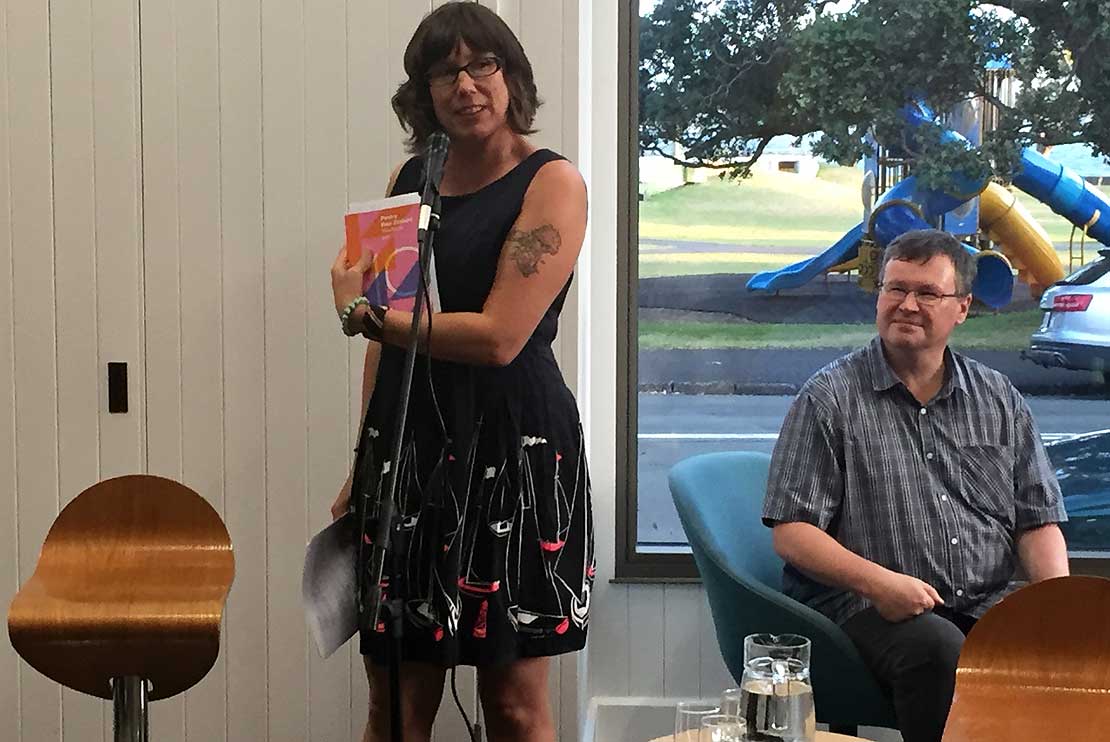


Poetry NZ Yearbook 2019's featured poet Stephanie Christie, about to read her work at the launch in Devonport Library, with Dr Jack Ross.
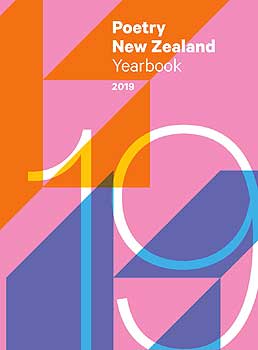


Poetry NZ Yearbook cover
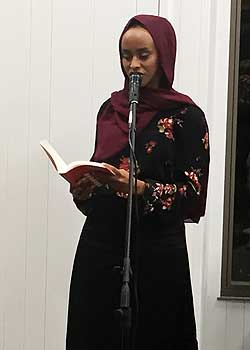

Poet Fardowsa Mohamed reads at the launch
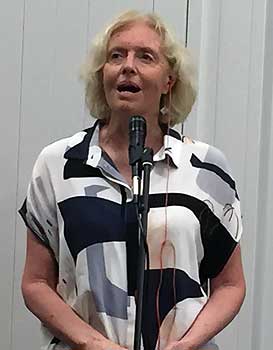

Poet Michele Leggott recites her new poem

Laugh, cry, take your breath away or send shivers down your spine – that’s how editor Dr Jack Ross hopes his selection of 120 plus poems in the Poetry New Zealand Yearbook 2019 will affect readers.

Launched last week at the Devonport Library in Auckland to a packed room of over 200, issue number 53 of New Zealand’s longest-running poetry journal and the third to be published by Massey University Press includes new migrant voices, veteran poets and even a veterinary professor-turned-poet.

Dr Ross, a poet, editor and senior lecturer in the School of English and Media Studies at Massey’s Albany campus, says the task of sifting through over a thousand submissions to choose 130 for the book is formidable as well as a tremendous privilege. Always with an ear tuned for fresh and challenging new voices and views, he has mustered a bracing array of poetry from a diverse set of writers.

From modern probes into religion, romance, love, death and loss to the inner lives of a retail worker, a refugee, a doctor, a drunk – the eclectic mix offers poems in a multitude of forms, including prose pieces. As well as captivating lines by emerging poets there is new work by some of the country’s most respected names, such as New Zealand’s inaugural Poet Laureate Michele Leggott, along with Elizabeth Smither, Emma Neale and Bob Orr. There are dual-text poems too, in Chinese, German, Spanish and te reo Māori, as well as 20 poems and an interview with featured Hamilton poet Stephanie Christie.

A number of Massey graduates and staff who are also published authors made the grade, including Professor Bryan Walpert, Dr Johanna Emeney, Dr Matthew Harris, Bonnie Etherington, Sue Wootton and Jessica Pawley, who wrote one of three literary essays in the book.

Wildbase vet a prize-winning poet


Another Massey contributor is Brett Gartrell, a professor in Wildlife Health in the School of Veterinary Science and clinical director of the Veterinary Teaching Hospital at the Manawatū campus. He gained second place and a $300 in prize money for his poem; ‘After the principal calls’.

Beyond his day job saving injured native birds and animals and teaching others how to do the same, he has been taking courses through the School of English and Media Studies for the past decade, including on fiction writing, creative non-fiction, children’s writing, life writing and poetry.

“I never thought of myself as a poet previously, but I was inspired by the teaching and poetry of Professor Bryan Walpert in particular,” says Professor Gartrell, who has just completed a portfolio of poetry and essay for his master’s of Creative Writing. “I’ve discovered poetry as something that both challenges and intrigues me.”

His foray into studying poetry has, he says, “given me a perspective on my teaching. I have been challenged and mostly delighted by the teaching excellence of my tutors and lecturers. I think all academics could benefit from this role reversal from time to time.”

What does he most like about writing poetry? “It’s the combination of creative flow and control. It’s the challenge of allowing a poem to find its own direction and surprising conjunctions which then needs to be followed by the control of distillation; of condensing and communicating the most complex of lyrical moments through the words and structure of the poem.

“As Jasper Fforde writes in First Among Sequels; “Whereas story is processed in the mind in a straightforward manner, poetry bypasses rational thought and goes straight to the limbic system and lights it up like a brushfire. It's the crack cocaine of the literary world.”

Poetry editor to ghost writer


“I feel the most proud of this volume,” says Dr Ross, of the fifth consecutive edition of the Poetry New Zealand he has edited, not including one as a guest editor some years ago.

He says in the book’s introduction, What makes a poem good?, that being moved emotionally has increasingly become his sense of a successful poem, which may be about something funny, or painful or revealing. “It’s not that I sit here boo-hooing as I read through all the submissions for each issue – but every now and then something in one of them sits up and looks alive, persuades me that something is being worked out here that might be relevant to others simply because it seems so relevant to me.”

Mostly, he hopes the book will help to make poetry more visible, more accessible and maybe ignite new interest among a wider, more culturally diverse audience. This edition is his last as editor for the time being – he is handing the editorial reins for the next issue over to Dr Johanna Emeney, a published poet and creative writing lecturer at Massey. He is hoping to be able to devote more time to working on his own writing, with a project in the pipeline to explore his longheld fascination about ghost stories and the psychology behind them.


Related articles


Massey University Press publishes 'Poetry New Zealand Yearbook'
Abundance of young voices in latest Poetry NZ
Te Reo surge in latest Poetry NZ
‘Machinery for imagining’ in Poetry NZ

Created: 13/03/2019 | Last updated: 13/03/2019

Sunday, 24 January 2016

Te Reo surge in latest Poetry NZ [22/1/16]


Dr Robert Sullivan (6 September 2015) photograph: Bronwyn Lloyd


This article, based on a press release by Jennifer Little, Senior Communications Advisor at Massey University, appeared on the Voxy.co.nz website on 22 January 2016:

The question ‘what is New Zealand poetry?’ is the overriding one for editor Dr Jack Ross, as he sifts through hundreds of submissions for Poetry New Zealand. His answer? We need to hear more Māori voices.

To remedy his observation that Māori poets have been overlooked in New Zealand publishing, he invited Māori poet Robert Sullivan to feature in the 50th issue and be Dr Ross’s second as managing editor of Poetry New Zealand, the country’s longest-running poetry journal. The volume includes an insightful interview with the poet canvassing a range of issues such as biculturalism, poetry and identity.

Dr Sullivan, who has Irish and Māori (Ngāpuhi) ancestry, shares his views on the ethics and entitlement of non-Māori writers using Te Reo. "I used to think if you’re not Māori you shouldn’t be using Māori terms because you don’t understand the significance, but I’ve changed my mind about that," he says in the interview. "I think it’s better to promote the use of the language. But bringing it into poetry - well, readers of poetry can be quite pernickety. They’ll look it up, and they’ll actually deepen an understanding of Māori poetics."

Sullivan, who heads the creative writing programme at the Manukau Institute of Technology and edited a 2014 anthology of 60 Māori poets titled Puna Wai Kōrero: An Anthology of Māori Poetry in English (AUP), says he’s discovered more Māori poets since the book was published. "The story of Māori poetry in English and the story of Pasifika poetry in English is, I think, one that still needs to be told."

He says the National Kapa Haka competition, Te Matatini, represents hope for the future of poetry in Te Reo Māori. "They might call it dance, but the lyrics are all poetry. And it’s flourishing. It’s got its own spot on Māori television … it’s not just haka that are being performed, there are waiata, love songs, tangi."

His ten new poems featured in Poetry New Zealand delve into childhood memories of growing up in Auckland, as well as tributes to his parents and grandparents.

In his introductory editorial, Dr Ross makes the case for biculturalism as an underpinning element in defining New Zealand poetry. "For all its faults and omissions and blind spots, the Treaty remains the foundation of our state, and we can’t ignore the principles of biculturalism embodied in it," he writes.

And while he welcomes the concept of New Zealand "poetries" as a: "rich gamut of cultures and language which now exist in our islands expressing themselves in many languages and forms", he feels that "no definition of New Zealand poetry which attempts to sideline or depreciate poetry and song in Te Reo can be taken seriously."

He hopes more Māori poets will submit work in the future, in English and Te Reo Māori.

The 286-page volume, published last November by The Printery at Massey University, comprises poetry and prose poems by some 80 poets, including well-known names Elizabeth Smither, Owen Marshall, Peter Bland, Alistair Paterson, Siobhan Harvey and David Eggleton.

New Zealand poets based overseas and newcomers to New Zealand from diverse ethnic backgrounds are all part of the line-up, with a number of contributors either based in, or originating from, Bosnia, Canada, the United States, Scotland, Australia, and Japan.

Massey University writers include award-winning poet and Master of creative writing graduates Sue Wootton and Janet Newman, and award-winning poet and PhD in creative writing graduate Dr Johanna Emeney, as well as creative writing tutors Dr Matthew Harris and Dr Bronwyn Lloyd, and lecturer Dr Bill Angus.

Essays, commentary and reviews on new poetry publications by a host of local literary talents provide incisive explorations of some of the newest voices on the New Zealand poetry scene.

Dr Ross has signalled further changes to the publication, with the next issue to be published early in 2017 by Massey University Press - a new press launched in 2015 and headed by veteran publisher Nicola Legat. To shorten the length of time some contributors have had to wait for a decision, he’s decided to confine submissions to a three-month period: from May 1st to July 31st of each year, beginning in 2016.

Dr Ross - a poet, editor and critic who teaches fiction, poetry, and travel writing in the School of English and Media Studies at Massey’s Auckland campus - in 2014 replaced distinguished poet, anthologist, fiction-writer, critic and retiring editor Alistair Paterson, who oversaw Poetry New Zealand for 21 years.

The journal originated in 1951 when poet Louis Johnson began publishing his annual New Zealand Poetry Yearbook.

Was there a stand out poem for Dr Ross? "It's hard to single out any one person from so stellar a list of contributors, but I found the two pieces sent me by young poet Emma Shi sounded to me like messages from a strange new country I'd never visited before. She is, I believe, a powerful new talent whom I hope to hear much more from in the future," he says.


Jennifer Little, Senior Communications Advisor at Massey University


Sunday, 22 February 2015

Talking Cats and Other Creative Creatures [20/2/15]


Defining NZ 28 (Feb 2015): 28


The above feature article, by Jennifer Little, appeared in the February 2015 issue of Massey's Defining NZ magazine:

“Sparks of light in an ocean of stultifying babble, laser beams penetrating the Stygian darkness of our contemporary linguistic wasteland” – this bold vision is articulated by Dr Jack Ross in his introduction to the poems he chose in his debut as managing editor of the Poetry New Zealand yearbook.

Ross’s editorship of New Zealand’s longest-running poetry journal, which first appeared in 1951, marks a literary coup for Massey – and for the School of English and Media Studies – as its new publisher.

With poems by new and diverse voices – from one on bullying called "Life is Unfair" by an adolescent girl to a poetics professor and feature poet Lisa Samuels’ “extravagantly experimental” works of linguistic acrobatics, plus several translated from foreign languages and many more from local and international poets – Ross’s issue #49 was launched auspiciously on Halloween at the Albany campus and in Wellington in December.

The bumper selection of 117 poems by 93 poets was siphoned from well over a thousand submissions sent in via post and email. Two essays, a review and brief notices of 25 new poetry books and magazines are also included in a fatter new format published annually instead of the previous two slimmer volumes a year.

Ross took on the role after being approached by former editor Alistair Paterson and publisher John Denny. He’d been the feature poet and cover image on issue #22, and is the author of several works of experimental poetry, including City of Strange Brunettes (1998), Chantal's Book (2002), and To Terezin (2007), as well as in foreign languages with Celanie, (which he translated from German – via French – into English). He also co-edited the trilogy of audio and text anthologies Classic, Contemporary and New NZ Poets in Performance (AUP, 2006-8).

His desire to surprise and stimulate readers of Poetry New Zealand is exemplified in a poem by Christchurch-based Chinese poet Wei Sun. It contains Ross’s favourite line in the book; “Holy shit! A talking cat!” – from the poem titled "OCD and Conversations with Cat".

The poem’s quirky yet touching surrealism underscores his search for “a freshness of outlook. There has to be something about each poem that makes me ask the question; ‘Is this a poem?’”

Also in the limelight was Creative Writing senior lecturer Dr Thom Conroy’s debut novel The Naturalist (Random House), true story set in 19th century New Zealand, Germany and London about German naturalist, botanist and explorer Dr Ernst Dieffenbach. It topped the Nielsen Weekly bestseller list for New Zealand fiction for weeks.

Creative Writing tutor and award-winning fiction writer Tina Makereti’s novel Where the Rekohu Bone Sings (Random House) also made the Nielsen Weekly bestseller list and was widely acclaimed for its original take on the cross-cultural complexities of being Māori, Moriori and Pakeha.

Poetry collections by the head of Massey’s Spanish language programme Dr Leonel Alvarado and creative writing tutors Joy Green and Tim Upperton were published as the Kete series by Manawatū’s HauNui Press -– packaged in handmade flax kete.

Award-winning playwright and theatre lecturer Associate Professor Angie Farrow’s new book of short plays, Falling and other short plays (Steele Roberts) was launched in December amid a season of her plays performed in Palmerston North, with a new season planned for Wellington this year.

To top off an exceptional year, the school co-hosted the Australasian Association of Writing Programmes conference (AAWP) at the Wellington campus from November 30 to December 2, held back-to-back with a colloquium on “Placing the Personal Essay”.

The events attracted a swathe of New Zealand and Australian creative writing and teaching talent. The launch of the Aotearoa Creative Writing Research Network (ACWRN), developed by Thom Conroy, was a welcome initiative for those attending to connect more readily across distances as a community of academics, artists and teachers.

These are just highlights in a year of abundant literary output and success by staff and students, says Associate Professor Joe Grixti, head of the School of English and Media Studies.

“With numerous public readings, book signings, theatre performances, media interviews and reviews that accompany publication, Massey’s name is increasingly becoming synonymous – not just with agribusiness, veterinary science and social work – but with highly original creative writing.

“It's very timely for us to be nurturing provocative new voices and perspectives – we need creative ways to illuminate and understand the complexity of human experiences beyond the mainstream.”

Massey teaches a range of undergraduate creative papers internally and by distance (travel, fiction, poetry, theatre) as well as a Master of Creative Writing. For more information go to www.massey.ac.nz


Jennifer Little, Communications Advisor at Massey University


Wednesday, 4 June 2014

Massey editor for new-look Poetry NZ [28/5/14]


Jack Ross
Dr Jack Ross


The following press-release, by Jennifer Little, first appeared on Massey News on 28th May 2014. it also appeared in the NZ Book Council's online newsletter Booknotes Unbound on 29th May.

Watching an Al Jazeera television item about a young Arab poet spraypainting words of protest on a wall somewhere on the West Bank struck a chord with Massey University English senior lecturer Dr Jack Ross.

In his new role as managing editor of the country’s longest-running poetry journal, Poetry New Zealand, he hopes to infuse something of the spirit and energy of that far-flung poet in future issues of his new literary baby.

In the spirit of his predecessors at the helm of the periodical, he intends to keep it youth-oriented, politically engaged, experimental, and culturally diverse – all necessary attributes for an international journal of poetry and poetics.

Ross – a poet, editor and critic who teaches fiction, poetry, and travel writing in the School of English and Media Studies at the Albany campus – replaces distinguished poet, anthologist, fiction-writer, critic and retiring editor Alistair Paterson, who held the role for 21 years.

From this year, Poetry New Zealand will be edited and published by Massey’s College of Humanities and Social Sciences. An agreement was signed by its head of the School of English and Media Studies, Associate Professor Joe Grixti, Poetry New Zealand’s former managing editor Paterson, and production manager John Denny, for the future housing of the magazine by the university.

The journal originated in 1951 when poet Louis Johnson began publishing his annual New Zealand Poetry Yearbook. Johnson’s series stopped in 1964, but a bi-annual version re-christened as Poetry New Zealand was revived by Frank McKay in the 1970s and early 80s with a total of six issues, each with a different guest editor. It began appearing twice yearly under Oz Kraus at the end of the 1980s, initially with a series of guest editors and then with Paterson at the helm.

Currently working on his first issue, the 49th in the series, which is due out in October this year, Ross says the journal will continue to feature work primarily by established local and some overseas poets, as well as commentary and reviews. Pivotal to attracting and fostering a new generation of poets is his wish to showcase emerging – and inevitably challenging – poetic trends, voices and styles.

“There will still be a featured poet in each issue – but we’ll have to wait and see who’s been chosen to inaugurate the new yearbook version. It may be surprising to some!” he says. “Poetry New Zealand is for readers and poets who crave stimulation and real challenges from encountering experimental work that’s not always immediately accessible,” he adds.

He’s keen on the idea of including some foreign language poetry in translation by overseas-based or migrant writers living here.

Cosmetic and technological changes are afoot too. The feature poet’s portrait as the cover will be replaced with fresh new artwork. Contributers can also submit their work electronically for the first time. And instead of two issues per year there’ll be an annual edition with roughly twice the number of pages.

The changes will not only open up new directions for readers and writers, but an opportunity for graduate students studying creative writing and communication at Massey’s three campuses in Auckland, Wellington and Palmerston North to become involved in editing, design and layout through internships.

“It [Poetry New Zealand] will help complement the link between teaching and doing your own work. It’s good for students to see that while you are at university, even in arts and literature you can be learning in a pragmatic way. These are real world skills.”

Ross, who was featured in Poetry New Zealand’s Issue 22 in 2001 and guest-edited Issue 38 in 2009, has a wealth of experience in writing, editing and teaching poetry. He shares his poetic interests via a highly stimulating literary blog, The Imaginary Museum.

No stranger to experimenting with genre, as in City of Strange Brunettes (1998), Chantal’s Book (2002), and To Terezin (2007), as well as in foreign languages with Celanie, (which he translated from German – via French – into English), he also co-edited the trilogy of audio and text anthologies Classic, Contemporary and New NZ Poets in Performance (AUP, 2006-8).

While he acknowledges editing Poetry New Zealand is a time-consuming labour of love fitted around a busy teaching and PhD supervision schedule, he will be supported by an advisory board including Massey academics, poets and editors Dr Thom Conroy, Dr Ingrid Horrocks and Associate Professor Bryan Walpert; along with poet and academic Dr Jen Crawford; publisher and printer John Denny; poet and 2013 Burns Fellow David Howard; poet and editor Alistair Paterson ONZM; and poet and academic Dr Tracey Slaughter.

Ross says his ultimate aim is to make Poetry New Zealand as relevant and rivetting to a new generation of readers and writers as the most powerful films, novels and digital content. Like the graffitied words of that young Arab poet.


Dr Ross on an earlier Poetry NZ cover